Wednesday, June 07, 2023

 Georges Beuville ( 1902-1982)


Ok, this one is an odd one.

I remember seeing his work as a kid in books we had to read in class.

I didn’t care for it. I didn’t dislike it, it was just one of those things that I associated with class so it was boring.

It was later, in high school, when I was doing research in the library of the little town I lived in ( Vesoul!) that I fell on a book he had illustrated. It was a classic French book called the war of buttons ( La guerre des boutons) and I remember recognizing his little star shaped signature and trying to figure out if I liked it his work or not.

I couldn’t stop wanting to come back to it. I wasn’t sure why because it wasn’t well drawn. In fact, it felt like there was no drawing at all ( in my mind). Just colors that somehow made me understand a scene.

Later still, in college, I came across his work again and it THEN it hit me what he was doing.

The looseness of his work meant a lack of talent, or skill when I was younger, probably because I was used to French graphic novels or American comics which all had clear dark outlines.
Beuville’s work was different. It was so loose it felt more like a sketch than an illustration but it was clear, readable. It was expressive in a way that I didn’t know could be done and printed.

After that, I kept looking for his work whenever I could.

I found a lot since then, but nothing that impacted me as much as his La Guerre des Boutons”

Not to say his other work isn’t as good but that was the work of his that really impacted me the most. The kind of work that feels like a secret when you discover it if that makes sense.

“OH, You can do illustrations like THIS and it still works!”


Beuville’s done a lot of line drawing images that go inside the books, chapter headers, things like that. I love those as well.


In any case, another one of my favorites even if it took awhile for me to see it. ( which seems to be a recurring theme in my life!)


Thursday, June 01, 2023

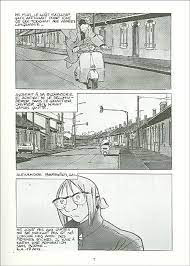
Jerome K Jerome Bloche


 Jerome K Jerome Bloche


This is the issue with posting about these graphic novels and artists here, it’s too limited!
There is SO much I would want to say about THIS particular series and so many images to share.
BUT, this is a series that started about 40 years ago in the pages of Spirou magazine.
It started out with Dodier and Makio as creators and along the way, it became just Dodier doing both the stories and the art.
What hooked me into this series is the storytelling. EVERYTHING is normal, real. Nothing is exaggerated, except maybe for the clumsiness and appetite of the main character. A Parisian Private Eye, fan of old US noire movies and books. His fiancee, Babette is the other strong(er?) part of the book for me.

The look is seemingly simple.There are no artifact, no pushed anatomy, no flying vehicles, no caricature of people or actions. Everything feels like it could be shot with a camera. And in many cases, it was. I’ve read interviews with Dodier where he talks about going from place to place, taking pictures as references for his shot.
He seems to pay particular attention to how the shots flow from one to another, creating moody intense sequences.
The earlier books had a greasier line, versus a sleeker, more precise line today.
Both are good. The earlier one was a little less refined but offered a lot of spontaneity which suited the series then, when Dodier’s storytelling wasn’t as thought out as it is today.
In the later books, the line is cleaner, the intent of the shots and sequences are stronger.
As the series evolves, it becomes less of a comedy and more of a social commentary ( in my opinion) but never loses it’s sense of fun either.
It’s just a great series. Each book is a full standalone episode, but if you read the series from the beginning, you get introduced to recurring characters and you see the protagonists evolve, grow, mature.

A special note about the colors as well.
They are done by a studio called “Cerise”, operated by a wife and husband duo. Cynthia Englebert and Gianluca Carboni. I find their approach to enhance the story rather than simply be” there”.

Overall, Jerome K Jerome Bloche is a series that I particularly loved growing up and that I read and re read every so often.
I know they’ve been translated and published in English.

#Dodier #Makyo #JeromeKJeromeBloche


Sunday, May 28, 2023

L'Autoroute du soleil


L’Autoroute du Soleil, by Baru.


This graphic novel was published in 1995.


The story follows two young adults running from 

People trying to kill them. It’s a buddy road trip movie. The title of the book refers to the main highway that connects the south of France to the Northern part of it. ( not the ONLY road, but it’s a cool name. It translates to “ The Highway of the sun”


At the time, I hadn’t yet read a graphic novel like this.

Black and white, it was long too. Over 400 pages. It felt real.

I had known of Baru’s work for a while by then. He had done a book or a series, I can’t remember called “Quequette Blues” I think it was published in a magazine like A suivre or Pilote. I wasn’t interested in it. I was probably too young then to connect to stories that felt SO MUCH like real life.


But when L’Autoroute du Soleil came out, it felt like I knew the characters in the book.

Not only that, but it felt like this was a story that could’ve really happened.


Put back in the context of the time, most of the stories in graphic novel form I was exposed to were either super hero comics or stuff like Tintin and Asterix( I mean, not JUST that but mostly that). The OTHER type of comic form I would see in stores was adult only stuff.

So when I found L’autoroute du Soleil, it was a shock. It felt like a movie on paper.

Everything about it worked. The graphic nature of the characters, They were not pretty. Not all of them. Some were down right ugly, just like in real life.

People coming in and out of the story. Having an impact then disappearing, like a person you meet on the train and is gone at the next stop.
I grew up in the south of France and when the main characters stop for a while in the South, I thought I could hear the cicadas and feel the heat of long summer days


The staging, editing, the rhythm of the story felt like it was shot with a camera. The story itself was a very urbane, believable story with (almost) believable human reactions. There was just enough “extra” to make you want to read more. The night shots felt moody and real and the sequences where the characters relax on the beach feel breezy, sunny and fun. I wasn’t used to author who were so comfortable in light sequences as well as moody, tense moments. 


It was the beginning of an era where I could see graphic novels as a full art. Not for kids, not for bizarre stories that no one would read or care for, but for very mature, skillfully crafted movies on paper. This book didn’t have color and I didn’t even notice. It was that engrossing.

I re read the book a few weeks ago and I am STILL completely involved in the story.


I feel these stories are more common today.

I find similar real life feelings in some mangas. There are some American Graphic Novel artist that have been going down that road as well and I love it.


Baru has done other amazing books since then.

He did one about a boxer a little later that I find absolutely amazing as well.

I believe he is still active and whenever I get a chance to find some of his work, I’ll read it.


#Baru #L’autoroute du Soleil